A cheeky note before we get into the life story.
You might have noticed I really like using Sisyphus as an allegory for running a business. For me, it captures something that’s hard to explain. However well things are going, there’s still a boulder to push uphill. And sometimes it feels like you’re the only person stopping it from rolling all the way back down.
I refuse to be yet another pretentious douchebag promising you easy solutions and hands-off retirement by the end of next week. Lies like that are easy to tell. I’d find them considerably harder to live with.
What I can do is help you find better ways of pushing the damn thing. Better paths to take. Pitfalls to watch out for. Ways to make it… less painful. There’s plenty to enjoy along the way, too. Building a business that pays its way and produces a steady profit is enormously satisfying. As it becomes more stable, you get more room to appreciate what you’ve built and the people it supports. That boulder starts to mean something. It represents your effort and responsibility for your family’s future and the livelihoods of the people working alongside you. You must always be proud of it, even on the days you’d quite like to leave it halfway up the hill.
Wait a second. What was I saying about being a pretentious douchebag? Dammit.
FOUNDER'S STORY

I started with a £400 pressure washer. The expensive lessons came later.

I’m Alex, the founder of Fix That Business and CAPS Cleaning Ltd.
About four years ago, I started CAPS in South Wales with a £400 beat-up, second-hand pressure washer. In under two years, I’d built a company with two vans, employees, six-figure turnover and our own cherry picker.
That’s the version you can fit into an introduction.
There’s considerably more behind it.
There were inconsistent enquiries, bad business decisions and jobs lost to silly mistakes. There were systems that depended far too much on someone remembering to do something. There were countless days I could have spent with my family that went into work because I hadn’t yet found a better way to run it.
I’m proud of what we built. I also know what it cost to get there.
Both are part of why Fix That Business exists.
Learning while the business kept moving
My background includes marketing education and a career in corporate management. Those gave me experience I could draw on, but running CAPS put it to work under very different conditions.
I had to find customers, assess jobs, work out prices, send quotes and organise the work. I also had to deliver it.
A quote needed to cover the time, labour, access, equipment and materials involved. An advert needed to bring enquiries from people who might actually book. A follow-up needed to happen while the customer was still interested.
Every decision had a practical consequence.
When you’re doing the work yourself, you feel those consequences quickly. You find out when you’ve underestimated a job. You notice when you’ve spent money on advertising without getting enough back. You remember the customer you should have called.
I’ve made mistakes in those areas. Some cost money. Some cost opportunities. Some added more work to days that were already full.
I’ve never forgotten how frustrating it is to work hard and still feel that something in the business is getting in your way.

BUILDING CAPS
CAPS grew into roof cleaning, gutter cleaning, pressure washing, softwashing and commercial exterior cleaning. As the work developed, so did the demands behind it. Different surfaces needed different methods. Bigger jobs needed more planning. Commercial work brought site assessments, access arrangements, risk assessments and method statements, insurance requirements and the coordination of people, equipment and working hours.
We took on work involving hospitals, car parks and larger commercial sites. Each brought practical decisions that had to be worked through properly. The business also grew beyond what I could carry around in my own head. More equipment meant more capacity, but also maintenance, storage and transport. Bringing people into the work meant making sure they had the information and preparation they needed. Having more jobs to organise meant a missed detail could affect someone else’s day as well as mine.
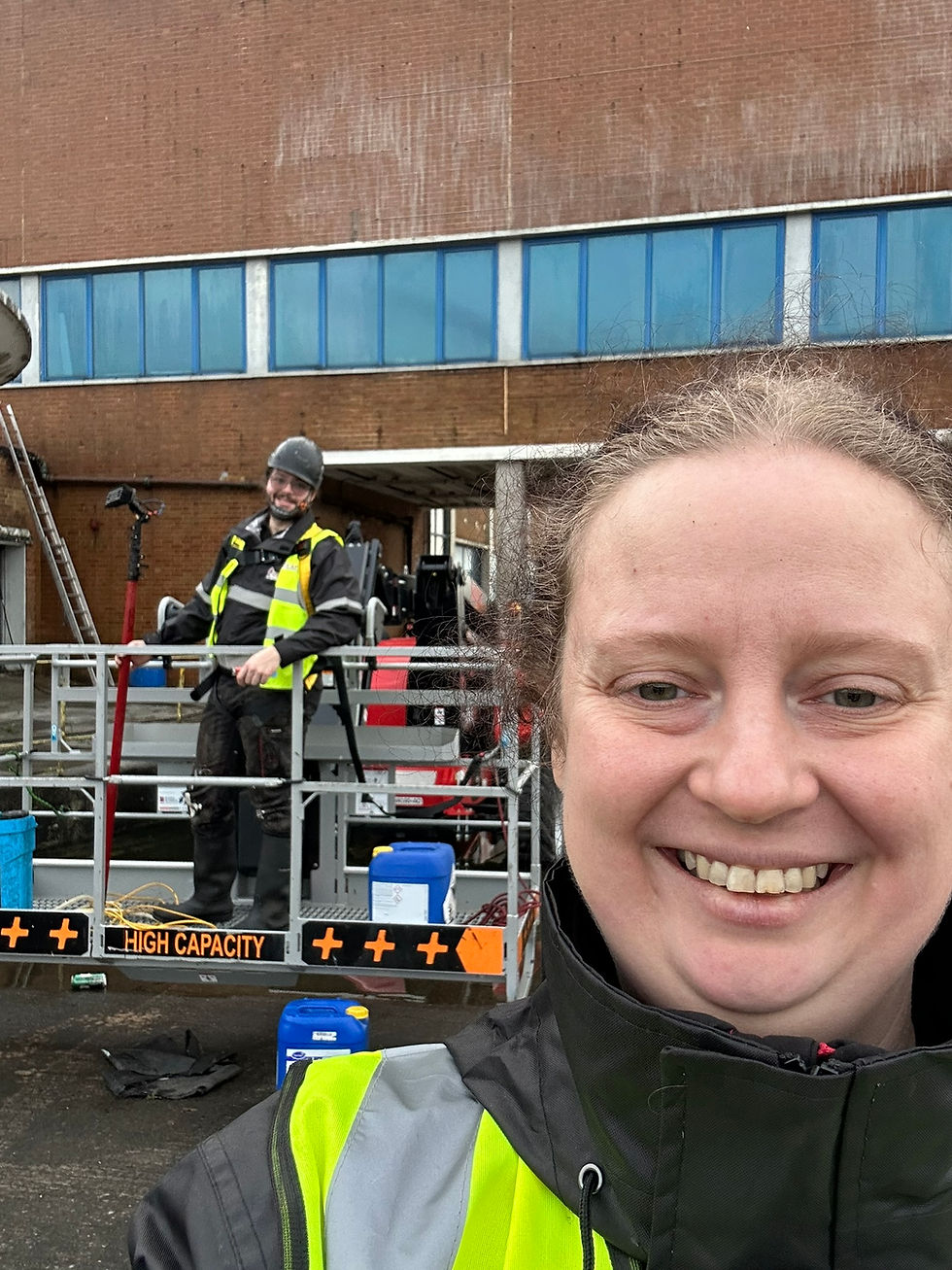
Chloe has been part of that journey too. We’ve worked together on site and on the customer contact, follow-ups and organisation behind it. The photograph of us in our work gear belongs in this story because that’s a real part of our life. Building the company has involved physical work, practical problem-solving and a great deal of learning along the way. The vans, employees and cherry picker are milestones I’m proud of. Behind them are all the smaller decisions that made the work possible.

Finding customers, then keeping track of them

Marketing became something I had to keep testing against the reality of the business.
I worked with Meta advertising, Google Ads, leaflets, local posts and outreach. I wrote copy, made videos, tested messages and thought about how to explain our services so customers could understand what they were paying for. I had to learn from the campaigns that disappointed me as well as the ones that brought opportunities. An enquiry still needed an answer. Someone had to understand what the customer wanted, arrange a survey where needed, prepare the quote and follow it up. A booked job needed to reach the diary with the right details attached.
There are plenty of places for things to slip between an advert and a completed job.
Running CAPS made me pay attention to those gaps. I wanted to understand what happened after someone filled in a form, where the information went and what prompted the next action.
That led me further into CRM systems and automation. I built workflows using spreadsheets, then my custom software, connected forms and customer records, and worked on the relationship between quotes, appointments and jobs. I connected email and SMS tools so confirmations, reminders and other messages could be triggered without someone having to send every one manually.
The details matter when you’re the person relying on the system. You need the address when you arrive. You need to know which quote the customer accepted. You need to see what has already been sent before contacting them again. I built these things around problems I was dealing with in my own business. I could use them, find the awkward parts and change them. I like figuring out how things work. That instinct runs through much of what I do. Sometimes it means working through a customer journey or fixing a spreadsheet. Sometimes it means designing equipment around how we actually work.
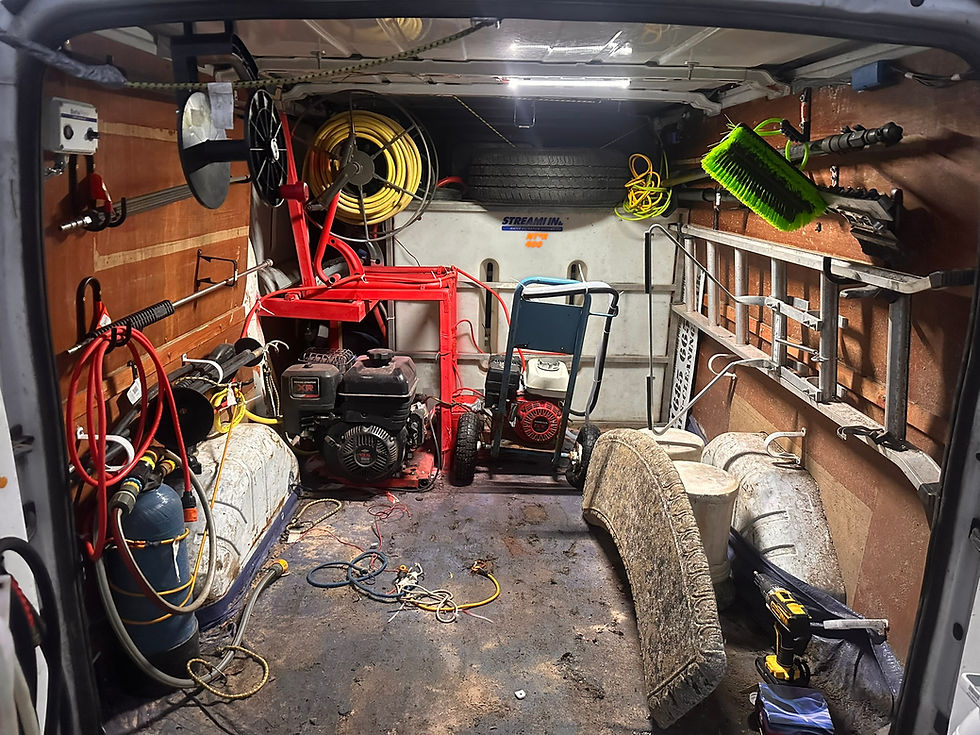
One of my projects at CAPS was building our twin-power pressure-washing setup, Betty MK4. Pumps, washers, heating, reels and the van layout all had to work together in a way that made sense on a job.
The point was to save time and make the work easier to deliver.
I take a similar interest in the less visible parts of a business. I want to know why information is being entered twice, why a quote takes so long to prepare or why a follow-up depends on someone remembering it at the end of the day. There’s tremendous satisfaction in getting those things working properly. Especially when it removes a recurring frustration from someone’s week.

THE OTHER BUSINESSES TAUGHT ME THINGS TOO

Alongside CAPS, I’ve started other brands, including Prismee, an engraved-gift business.
Prismee brought a different set of decisions: products, personalisation, photography, descriptions, online shops, advertising and dispatch. I worked with laser engraving and explored different products and selling channels. It gave me another view of what happens when you’re trying to turn an idea into something people will buy. The experience of running a service business and selling physical products has made me careful about assuming the same approach will suit everyone. Customers make different decisions. Businesses have different costs, capacities and ways of delivering their work.
I’ve also helped friends and other business owners with parts of their businesses. That experience sits alongside my own ventures, and the examples elsewhere on this site explain the work I’ve been involved in.
Starting and working on different brands has given me more to draw on. It has also given me plenty of reasons to ask questions before recommending anything.

THE PART I CARE MOST ABOUT

I’ve been through the trial-and-error meat grinder. That phrase stays because it’s how the experience felt.
Some lessons were expensive. Others took time that I can’t get back. Poorly planned systems cost me days I could have spent with my family, and that has stayed with me more than any piece of equipment I’ve bought.
When you care about your business, it’s easy to keep giving it more. There’s always something else that needs attention. Another decision, another message, another problem to work through.
I know how much it takes to keep going when you’re uncertain about what comes next. I know the frustration of losing a customer through an avoidable mistake. I also know the relief of finally sorting out something that has been making the work harder for months. That’s the experience I want to put to use.
I want to help owners find customers, handle enquiries better and make practical improvements to how their businesses run. I want the work to give them more back for everything they put into it.
WHY I STARTED
FIX THAT BUSINESS

Fix That Business brings together my experience of running businesses, marketing, sales, systems and practical delivery. There are owners who want advice and someone to work through a problem with. There are others who have a clear idea of what they need but need help getting it built or done.
I can help with marketing planning and delivery, advertising, offers and follow-up, CRM workflows and automation. The starting point is understanding the business and agreeing where my help would be useful.
You know your customers, your work and the realities you deal with every day. I bring an outside view and practical experience of my own. We need both to make sensible decisions.
We’ll discuss what you want to change, what you can realistically take on and what the work will involve. We’ll agree the priorities, costs and scope before starting. The changes should make sense in your business. They should be understandable to the people using them. And you should know what’s been done and why.
I’m proud of starting with that £400 pressure washer.
I’m proud of the business Chloe and I have worked to build.
I’m still running it, still solving problems and still learning.
Now I’m putting that experience to work through Fix That Business.
Now, tell me what’s getting in your way.
Let’s work out how to fix it. Together.
- Yours Truly,
Aleksander Grzadziel
Founder of Fix That Business